LCL vs FCL From China to the UAE: When a Full Container Becomes Cheaper
Short answer
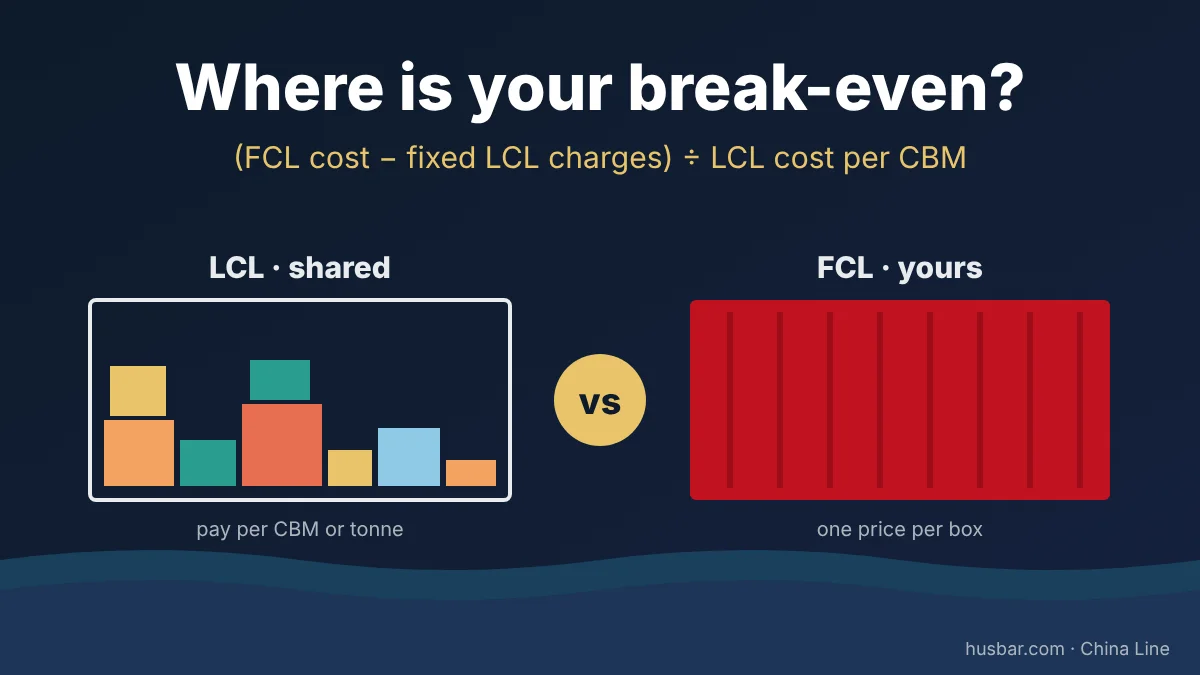
LCL (less than container load) means your cartons share a container with other shippers and you pay for the space you use, measured per CBM or per tonne, whichever is greater. FCL (full container load) means you book a whole 20ft or 40ft container and pay one price whether it is full or half empty. LCL is usually cheaper for small shipments; FCL becomes cheaper once your volume passes a break-even point, which for many China to UAE routes falls somewhere in the low to mid teens of CBM. The exact point depends on your own quotes, so the reliable way to decide is to divide the all-in FCL price by the all-in LCL price per CBM, which this guide shows step by step.
Key takeaways
- ✓LCL is charged per CBM or per tonne, whichever is greater (the W/M rule).
- ✓FCL is a flat price per container, full or not.
- ✓Your break-even CBM = FCL all-in cost divided by LCL all-in cost per CBM.
- ✓A 20ft container has about 33 CBM of internal space but you will load less in practice.
- ✓Compare door-to-door quotes, not ocean rates alone.
What is the difference between LCL and FCL?
Think of LCL as a shared taxi and FCL as hiring the whole car. In a shared taxi you pay for your seat, but you wait for other passengers and stop where they stop. Hire the car and you pay the full fare even if you travel alone, but nobody else touches your luggage and you leave when you are ready.
With LCL, your forwarder collects your cartons at a consolidation warehouse in China (a CFS, container freight station), loads them with other shippers' goods, and the container is unpacked again at a CFS near the destination port, such as Jebel Ali in Dubai or Jeddah in Saudi Arabia. With FCL, the container is loaded at your factory or your forwarder's warehouse, sealed, and opened only when it reaches you or customs inspects it.
| LCL (shared container) | FCL (full container) | |
|---|---|---|
| How it is charged | Per CBM or per tonne, whichever is greater | Flat price per 20ft or 40ft container |
| Best for | Small or test orders, mixed suppliers, frequent restocks | Larger, regular orders, fragile or high-value goods |
| Handling | Loaded and unloaded at warehouses with other cargo | Loaded once, sealed, unloaded at your end |
| Transit time | Usually longer: consolidation and deconsolidation add days | Usually shorter and more predictable |
| Damage and loss risk | Higher: more handling and shared space | Lower: your goods only |
| Customs risk | One shipper's problem can delay the whole container | Only your paperwork matters |
| Fixed charges | CFS, documentation and handling per shipment | Terminal handling and container fees per box |
How is LCL charged? The W/M rule
LCL is priced per revenue tonne using the weight or measurement rule, usually written W/M. The carrier compares your volume in cubic metres with your weight in metric tonnes and charges whichever number is bigger, treating 1 CBM as equal to 1,000 kg. Most forwarders also apply a minimum, often 1 CBM, so even a single small carton pays for at least one.
- Light, bulky cargo: 8 CBM of cushions weighing 1,600 kg is charged as 8 revenue tonnes, because 8 CBM is more than 1.6 tonnes.
- Heavy, compact cargo: 4 CBM of ceramic tiles weighing 6,000 kg is charged as 6 revenue tonnes, because 6 tonnes is more than 4 CBM.
- Tiny shipment: 0.4 CBM weighing 90 kg is usually charged at the 1 CBM minimum.
CBM itself is simple: length x width x height of a carton in metres, multiplied by the number of cartons. A 60 x 40 x 40 cm carton is 0.6 x 0.4 x 0.4 = 0.096 CBM, so 100 of them is 9.6 CBM. Our guide to how shipping cost from China to Dubai is calculated covers volumetric weight for air and express too.
How much actually fits in a container?
Published internal volumes are the theoretical maximum. In practice cartons do not fill every centimetre, the door is lower than the ceiling, and pallets waste space. Use the practical range below for planning and ask your forwarder to run a load plan for your exact carton sizes.
| Container | Internal volume (published) | Planning range for cartons | Max payload (typical) |
|---|---|---|---|
| 20ft standard | About 33 CBM | Roughly 25 to 30 CBM | About 28 tonnes, varies by box |
| 40ft standard | About 67 to 68 CBM | Roughly 55 to 62 CBM | Check the container's CSC plate |
| 40ft high cube | About 76 CBM | Roughly 65 to 70 CBM | Check the container's CSC plate |
Heavy goods hit the weight limit before the space limit. A container of tiles or metal parts may be legally full by weight while half empty by volume, and road weight limits at the destination can be stricter than the container's own rating, so confirm both with your forwarder.
How to calculate your LCL vs FCL break-even point
This is the part most guides skip, and it is the only part that matters for your decision. Rates move every week, so a rule of thumb from someone else's shipment is not enough. Use your own quotes and this formula:
Break-even CBM = (FCL all-in cost - fixed LCL charges) / LCL cost per CBM.
- Ask one forwarder for two door-to-door quotes on the same goods, same route, same Incoterm: one LCL, one FCL 20ft.
- From the LCL quote, separate the variable part (ocean freight and any charges priced per CBM or revenue tonne) from the fixed part (documentation, delivery order, flat clearance fees).
- Add up the FCL quote in full: ocean freight, terminal handling at both ends, documentation, clearance and trucking.
- Apply the formula. If your shipment is bigger than the break-even CBM, FCL is cheaper; if smaller, LCL is cheaper.
- Sense-check against capacity: if break-even is above what fits in a 20ft, the 20ft is not worth it at those rates.
Worked example (illustrative numbers, not market rates)
To show the maths without pretending to know this week's prices, use simple units. Say your forwarder's LCL quote works out to 100 units per CBM in variable charges plus 300 units of fixed charges per shipment. The FCL 20ft quote is 1,700 units all-in, door to door.
Break-even = (1,700 - 300) / 100 = 14 CBM. Below 14 CBM, LCL wins. At 14 CBM they cost the same. Above it, FCL wins, and every extra CBM you load into the 20ft is effectively free freight.
| Your shipment | LCL cost | FCL 20ft cost | Cheaper option |
|---|---|---|---|
| 6 CBM | 6 x 100 + 300 = 900 | 1,700 | LCL, by 800 |
| 10 CBM | 10 x 100 + 300 = 1,300 | 1,700 | LCL, by 400 |
| 14 CBM | 14 x 100 + 300 = 1,700 | 1,700 | Equal |
| 18 CBM | 18 x 100 + 300 = 2,100 | 1,700 | FCL, by 400 |
| 26 CBM | 26 x 100 + 300 = 2,900 | 1,700 | FCL, by 1,200 |
Now look at cost per unit sold rather than cost per shipment. If each carton holds 24 units and measures 0.096 CBM, 26 CBM is about 270 cartons, roughly 6,500 units. In the example, FCL saves 1,200 units of currency across 6,500 products: worth having, but small next to the risk of tying up cash in stock you cannot sell. Freight should never be the only reason to order more.
Want your product made, inspected and delivered without the risk?
Husbar China Line verifies factories, negotiates for you, arranges on-site inspection before you pay the balance, and manages freight to the UAE, Saudi Arabia and beyond.
Request a China Line consultationWhen LCL is the smarter choice even if FCL is cheaper
- You are testing a new product. A smaller first order protects cash while you prove demand. Our guide to choosing your first product to import explains why.
- You do not have warehouse space. A full container arriving at once can cost more in storage than you saved in freight.
- Your cash flow is tight. More, smaller shipments keep money moving and reduce the stock you hold. Pair this with safety stock planning.
- You buy from several suppliers. Your forwarder can consolidate shipments from multiple suppliers, and that may get you to FCL anyway.
When to book FCL even below break-even
- Fragile or premium goods. Glass, ceramics, furniture, perfume and electronics suffer from repeated handling at consolidation warehouses.
- Tight launch dates. FCL skips consolidation and deconsolidation, so arrival is usually more predictable.
- High-value or confidential products. Fewer hands touch the cargo and the seal stays intact from origin.
- Moisture-sensitive cargo. You control desiccants and packing for the whole box. See container moisture damage prevention.
- Peak season or disruption. When schedules are unstable, shared containers can wait longer for enough cargo to fill them.
Charges people forget in LCL vs FCL quotes
Ocean freight is often the smallest line. Compare these on both quotes before you decide:
- Origin charges: pick-up, export customs, CFS receiving fees for LCL, container stuffing for FCL.
- Surcharges: bunker or fuel adjustments, peak season charges and, on some routes, war-risk surcharges. See war-risk surcharges explained.
- Destination charges: terminal handling, delivery order, CFS unstuffing for LCL.
- Customs clearance, inspection fees, and import duty and VAT. See import duty and VAT from China to the UAE.
- Demurrage and detention for FCL if the container is not collected and returned on time.
- Final delivery from port or CFS to your warehouse.
A quick decision checklist
- Measure total CBM and total weight from the factory packing list, not estimates.
- Get LCL and FCL door-to-door quotes from the same forwarder on the same day.
- Calculate break-even CBM with the formula above.
- Check whether the goods are fragile, high-value, moisture-sensitive or time-critical.
- Check storage space and cash flow for a full container.
- Ask whether combining suppliers or delaying a week would get you to FCL.
- Put the freight result into your landed cost calculation before you set prices.
How Husbar China Line helps
Husbar China Line manages sourcing, production follow-up and shipping coordination for brands importing from China into the UAE and Saudi Arabia. We work out the break-even for each order, compare forwarder quotes like for like, and plan order sizes around your cash flow and launch dates, not just the cheapest freight. If you are deciding between a shared and a full container for your next order, send us your packing list at team@husbar.com or request a China Line consultation.
What is the difference between LCL and FCL?+
LCL shares a container with other shippers and is charged per CBM or per tonne, whichever is greater. FCL is a whole container at a flat price.
At how many CBM is FCL cheaper than LCL?+
It depends on your quotes. Divide the all-in FCL price, minus fixed LCL charges, by the LCL cost per CBM. On many routes the answer falls in the low to mid teens of CBM, but rates change, so calculate it for each shipment.
How many CBM fit in a 20ft container?+
A 20ft standard container has about 33 CBM of internal space. In practice, plan for roughly 25 to 30 CBM of cartons, depending on carton sizes and pallets.
Is LCL slower than FCL?+
Usually, yes. LCL cargo waits to be consolidated with other shipments in China and is unpacked at a warehouse at the destination, which adds days at both ends.
What does W/M mean in LCL shipping?+
Weight or measurement. The carrier charges on whichever is greater, your volume in CBM or your weight in metric tonnes, treating 1 CBM as 1,000 kg.
Can I ship goods from several Chinese suppliers in one container?+
Yes. A forwarder or sourcing team can collect goods from several suppliers at one warehouse and load them together, often as FCL.
Sources
- Hapag-Lloyd: 20' standard container specifications (internal capacity 33.2 cbm, max payload 28,130 kg), hapag-lloyd.com.
- Freight Figures: shipping container dimensions, nominal and usable CBM for 20', 40' and 40' HC containers, freightfigures.com.
- Cogoport: how to calculate chargeable weight in ocean freight (W/M rule, 1 CBM treated as 1,000 kg), cogoport.com.
- Dubai Customs: GCC common customs tariff information.
- UAE Federal Tax Authority: VAT on imports.
Team Husbar
Husbar Editorial
Team Husbar is the strategy, psychology and research team at Husbar, a psychology-led growth agency headquartered in Dubai. Together we have worked with 100+ brands over 10+ years.
Want your product made, inspected and delivered without the risk?
Husbar China Line verifies factories, negotiates for you, arranges on-site inspection before you pay the balance, and manages freight to the UAE, Saudi Arabia and beyond.
Request a China Line consultation